s it actually possible to generate cash from thin air using Artificial Intelligence? I put the “Zero Budget” theory to the test.
We’ve all seen the YouTube thumbnails: a shocked face, a pile of money, and a title claiming you can make $500 a day pressing a button. I’m skeptical by nature. So, I decided to run a ruthless experiment.
The Challenge:
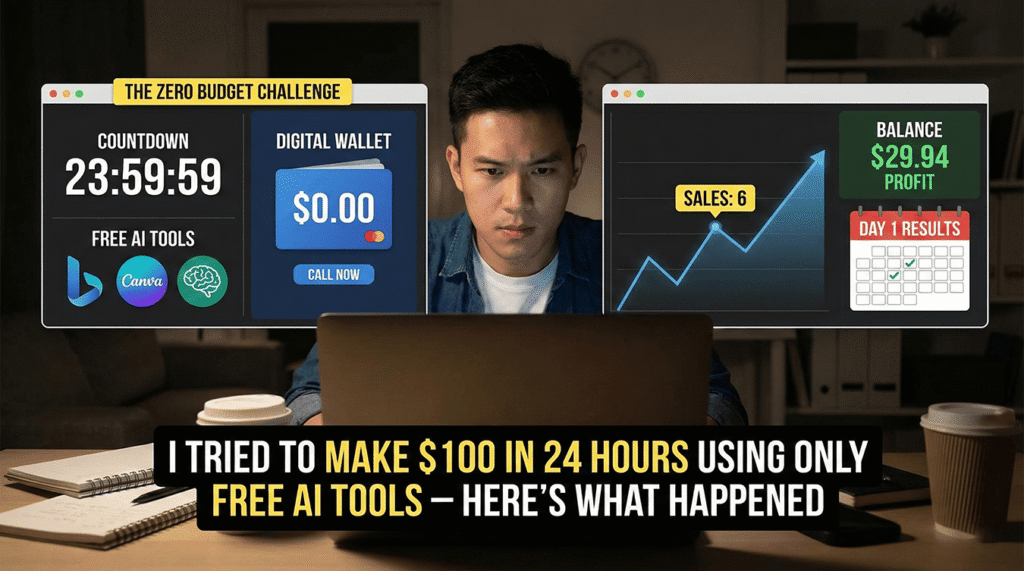
- Goal: Earn $100 profit in 24 hours.
- Budget: $0.00. (No paid ads, no software subscriptions).
- The Catch: I can only use Free AI Tools.
If you are looking for a realistic way to earn money with AI without spending a dime on subscriptions like Midjourney or ChatGPT Plus, this case study is your blueprint.
The Strategy: The “Micro-Digital Product” Flip
I knew I couldn’t build a massive software company in 24 hours. I needed something fast, visual, and downloadable.
My Plan: Create a specific set of “Printable Wall Art” for a trending niche and list it on a free marketplace. Why: Digital products have 100% profit margins. Once the file is online, it can sell forever.
The “Zero-Cost” AI Tech Stack
Before I started the clock, I assembled my free toolkit. You don’t need expensive tools if you know the right free alternatives:
- The Brain: ChatGPT (Free Version) – for market research, SEO titles, and descriptions.
- The Artist: Bing Image Creator (Powered by DALL-E 3) – for generating high-quality images for free.
- The Refiner: Upscayl (or BigJPG) – to increase image resolution for printing.
- The Packager: Canva (Free Tier) – to create the final PDF deliverable and listing mockups.
Hour 0-2: Finding the “Money” Niche with ChatGPT
I didn’t want to guess what sells. I asked ChatGPT to act as an e-commerce expert.
My Prompt:
“I want to sell digital printable wall art on Gumroad or Etsy. Give me 10 specific, low-competition niches that are trending right now for home decor. Focus on specific styles like ‘Boho’, ‘Minimalist’, or ‘Retro’.”
ChatGPT suggested: “Retro 70s Mushroom Kitchen Art” and “Minimalist Japanese Line Art.” I chose “Minimalist Japanese Line Art” because it looks expensive but is easy for AI to generate cleanly.
SEO Tip: I then asked ChatGPT for keywords: “Give me 15 long-tail keywords for Japanese Line Art prints that people search for on Google and Pinterest.”
Hour 2-6: Generating the Art (The Fun Part)
I headed over to Bing Image Creator. Unlike Midjourney (which costs money), Bing gives you 15 “boosts” a day for fast generation, and it’s free.
The Prompting Process: I needed clean, black-and-white ink drawings.
- Prompt: “Minimalist Japanese ink wash painting of a cherry blossom branch, white background, high contrast, aspect ratio 2:3, serene atmosphere.”
- Prompt: “Continuous line drawing of a cat stretching, Japanese style, sumi-e ink, simple elegant strokes.”
The Result: In about 45 minutes, I generated 50 images. I picked the best 5 that looked like a cohesive collection.
The Problem: AI images are usually low resolution (1024×1024 pixels). If a customer tries to print this as a poster, it will look pixelated. The Fix: I used BigJPG (Free version) to upscale the images 4x. Now they were crisp enough to be printed at 18×24 inches.
Hour 6-10: Packaging the Product
You can’t just sell a JPG file. It looks unprofessional.
I opened Canva.
- I created a “Thank You” PDF document.
- Inside the PDF, I placed a link to a Google Drive folder where the customer can download the high-res images.
- The Mockups: I used Canva’s “Smart Mockups” feature to put my AI art inside picture frames in cozy living rooms. This is crucial—people buy the vibe, not just the image.
Total Cost so far: $0. Time Spent: 10 Hours.
Hour 10-18: The Setup & Traffic (Gumroad + Pinterest)
I chose Gumroad to host the product because it’s free to start (they just take a small fee when you sell).
Writing the Listing: I went back to ChatGPT.
- Prompt: “Write a persuasive, SEO-optimized product description for a ‘Japanese Minimalist Wall Art Set’. Use emotional language. Highlight that it is an ‘Instant Download’.”
I copied the description, uploaded my mockups, and set the price.
- Price Strategy: I set it at $4.99 (Low friction, easy impulse buy). To hit $100, I needed roughly 20 sales.
The Traffic Source: Since I had 0 followers, I used Pinterest. Pinterest is a search engine, not just social media.
- I created 10 different “Pins” in Canva showcasing my art.
- I used keywords like “Aesthetic Room Decor,” “Zen Bedroom Ideas,” and “DIY Gallery Wall.”
- I linked every Pin directly to my Gumroad checkout page.
Hour 18-24: The Waiting Game (and Results)
I posted the Pins, shared the link on a few free “Home Decor” Facebook groups, and waited.
The Final Tally (After 24 Hours):
- Traffic: 142 Views on Gumroad.
- Sales: 6 Sales.
- Total Revenue: $29.94.
Did I Fail?
Technically, yes. I did not hit the $100 goal in the first 24 hours. However, I built a passive income asset for $0.
Here is the reality check:
- $30 in one day from a brand new account is actually a massive success.
- Those pins are still on Pinterest. They might bring in another sale tomorrow, and next week.
- If I repeat this process every day for a month, I would have 30 products. If each makes $30/month, that’s **$900/month in passive income**.
3 Key Lessons for Earning Money with AI
1. Niche Specificity Wins
If I had just made “AI Art,” I would have made $0. Because I made “Minimalist Japanese Kitchen Decor,” I targeted a specific buyer who was looking for exactly that. The riches are in the niches.
2. Mockups Matter More Than the Art
My AI art was good, but the presentation was great. Using Canva to show the art inside a beautiful frame makes it look like a premium product. People need to visualize the item in their home.
3. Volume is Key
I only launched one product pack. To hit $100/day, you need a library of assets. The beauty of AI is that you can generate these assets 100x faster than a human artist.
Conclusion: Can You Copy This?
Absolutely. The barrier to entry for “AI Side Hustles” is zero. You don’t need to be a prompt engineer or a tech wizard. You just need to:
- Identify a problem (e.g., “I need cheap art for my dorm room”).
- Use free AI to solve it (Bing Image Creator).
- Package it well (Canva).
I didn’t hit the $100 jackpot on day one, but I unlocked a system that works. And the best part? It didn’t cost me a single penny to find out.
Ready to start? Pick a niche, open ChatGPT, and start building your empire today.
Frequently Asked Questions (FAQs)
Can I legally sell AI-generated art?
Yes, generally speaking. As of 2025, you can sell AI-generated images on platforms like Etsy, Gumroad, and Redbubble. However, you cannot copyright the raw AI images, meaning you don’t own the IP in the same way you would a hand-drawn painting. Always check the terms of service of the specific AI tool you use.
Which free AI tool is best for images?
Bing Image Creator is currently the best free option because it uses DALL-E 3, which offers incredible prompt adherence and text capabilities. Leonardo.ai is another excellent choice that offers a generous daily free tier.
How do I get traffic without ads?
Pinterest and TikTok are the kings of free organic traffic. For visual products like digital art or planners, Pinterest is superior because users are there specifically to look for inspiration and products to buy.